This is a grassroots
effort. Anyone is welcome to participate.
Jon Williams, Former Director North Carolina Alcohol Beverage Commission (NCABC) appointed by Governor Beverly Perdue There are many levels of supervision. There are 17,000 retail locations to buy alcohol across the state. Alcohol is part of the hospitality industry. Every weekend someone is shot or stabbed at a club. There are 3 main areas of focus addressed by NC ABC: Public Health, Public Safety and Fair commercial business regulations. NCABC seeks to partner with other groups working in these areas. 40% of inmates were under the influence of alcohol when they committed the crime. 50% of domestic violence cases involve alcohol. The key to successful alcohol regulation is communication and dialogue such as we are having today.
An Alcohol Roundtable was held attended by over 45 citizens including PAC facilitators, Mike Herring NC ABC Chief, Renee Cowick, NC ABC Attorney, Jeff Lasater, NC ALE, now retired Deputy Chief Steve Mihaich and other county, city and state officials. The outcome was a list of standards that citizens follow to assist the permitting process (approval or denial). Click here
Alcohol Watch Group. PAC Facilitators and concerned citizens make up this team
PAC 1: Jesse Gibson, Wanda Boone
PAC 2: Nancy Kneepkens, Peter Katz
PAC 3: Mindy Solie, Patricia Burchett
PAC 4: Harold Chestnut
PAC 5: No Representative
NEW PERMITTEE PROCESS Want to know more? click here
Indy, V. Coleman - To
legally sell alcoholic beverages in North Carolina, a business must obtain the
appropriate permits from the North Carolina Alcoholic Beverage Control
Commission. But to do business in the city of Durham, the retailer who hopes to
sell beer and other alcoholic beverages will also need a beer and wine
privilege license. Here's how the process works:
The
applicant submits a completed application for a retail permit with the
commission.
Upon
receiving a temporary permit from the ABC Commission, the applicant may legally
sell alcohol. During the 90-day term of the temporary permit, officials from
Alcohol Law Enforcement (ALE) in the North Carolina Department of Public Safety
will conduct an investigation of the business to verify information contained
in the application and that the business is operating in compliance with ABC
law.
To
obtain a permanent permit, the applicant is required to submit a Local
Government Opinion form to the designated municipal office for consideration.
(In Durham, that's the Durham Police Department.) The local government office
has 15 days to process the form, which includes zoning compliance, fire code
and criminal background checks of the applicant. It also has 15 days to object
to the issuance of a permanent ABC permit.
Once
the permit is obtained, the City of Durham requires that businesses apply for
the beer and wine privilege license with the city's Business License Unit. The
license applications are processed by the city's finance department and
approved by the Durham City Council.
CITIZEN ALCOHOL OUTLET PERMIT ACTION CHECKLIST
1. Receive Notification of Permit from PAC Listserves - Officer Massimo
2. Check
surrounding crime data using RAIDS ONLINE -
PACs
3. Check
compliance check data ALE or TRY
4. Check
alcohol purchase survey data - TRY
5. Citizen
Observations - PACs
6. Inform
Durham Public Schools of the permit request - Officer Massimo
WHO TO CONTACT:
Compliance (sales to minors, etc.) ABC Investigator Ray Richardson or Keith Whitfield (919) 294-8906
Reopening under a different name: Mike Herring Mike.Herring@abc.nc.gov Provide any new information you may know like new owners name and new name of business. Concerned about a current permit holder: Contact the Durham Police Department NC ABC Legal Department: Renee Cowick renee.cowick@abc.nc.gov; Tim Morse tim.morse@abc.nc.gov; LoRita Pinnix lorita.pinnix@abc.nc.gov; or Fred Gregory fred.gregory@abc.nc.gov). They can take your information and use it to start building a file.
Renee Cowick: A site deemed no longer suitable (meaning no business for 3 years at the location) must be ordered by a judge. The outcome is determined by the settlement agreement offer in front of the judge. Administrative Hearings are scheduled 3 months in advance. Witnesses are sent subpoenas through the Sheriffs department.
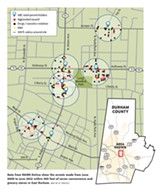
Above from Indy Weekly reporter V. Coleman
Why do we care? View Powerpoint Presentation here
Partners Against Crime (PAC)
| |||||||||||||||||||||||||